
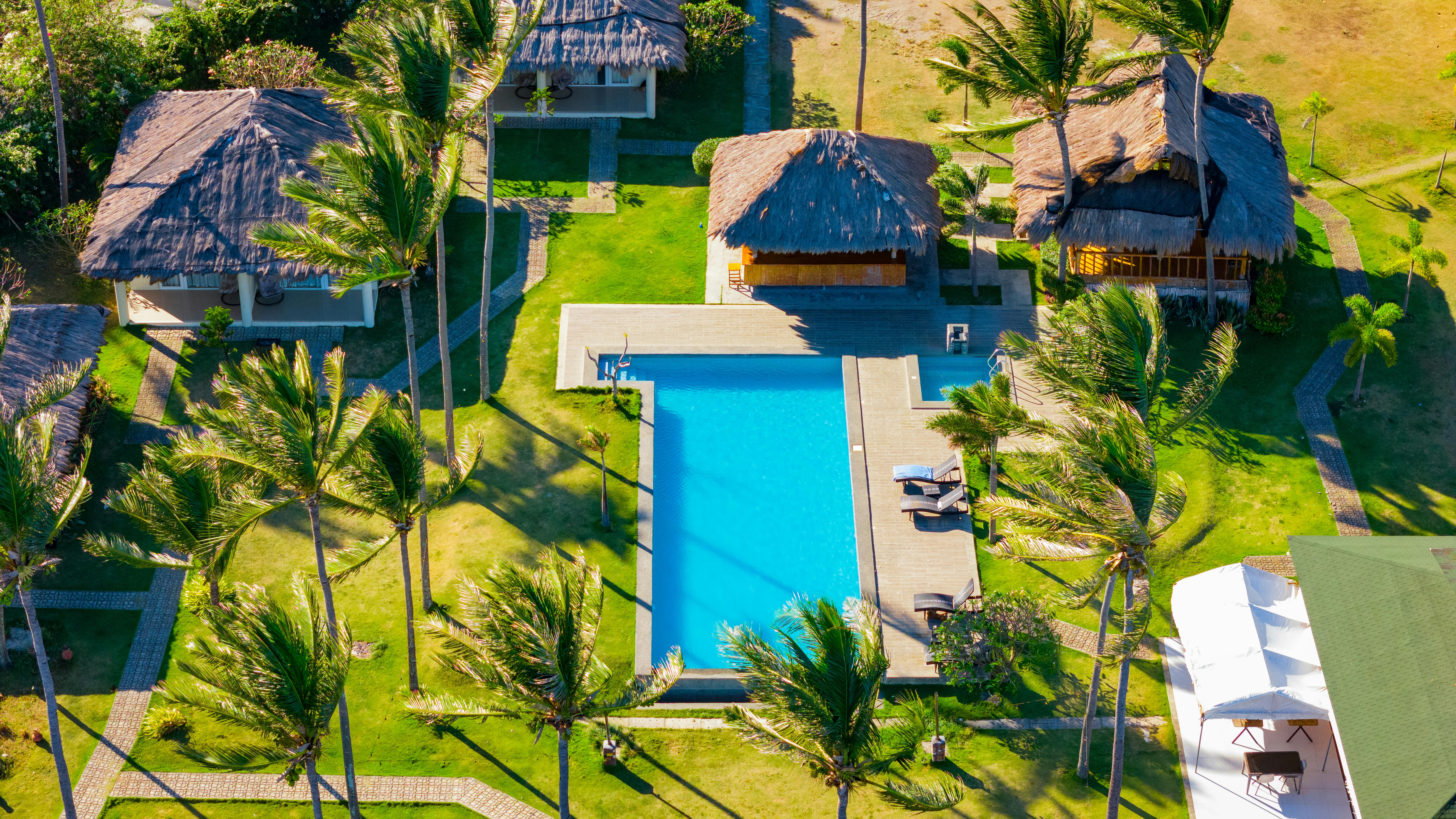
Multiple pools at a resort are not redundancy. They exist to separate groups whose ideas of a good afternoon are incompatible, and the separation is engineered.
Noise is the variable being managed
Families with young children, groups seeking music and bars, and guests wanting quiet cannot share one body of water without at least two of them being unhappy.
Zoning solves this by giving each a pool with its own character, sound level and service style, usually placed at a distance from the others.
Where a resort has only one pool, it must choose which group it serves, and that choice shows up clearly in reviews from the group it did not choose.
Depth and shape follow the intended use
Family pools are shallow across most of their area with a graded entry, which makes supervision straightforward and reduces the depth of any incident.
Adult pools are often deeper and more regular, sometimes with a swimming lane, since the use is different and the safety profile is simpler.
Activity pools with slides or wave features are built separately again because their equipment, filtration and supervision requirements do not fit alongside quiet swimming.
Adjacency decides the atmosphere
What sits beside a pool matters as much as the pool itself. A swim-up bar creates one environment, a spa terrace creates another, and a kids club creates a third.
Resorts place these deliberately, and the resulting zones are usually stable through the day and evening.
Guests reading a resort map before arrival can identify which pool suits them, and can ask for a room near it rather than discovering the arrangement on the second day.
Adult-only zones are a defined product
Age-restricted areas exist because a substantial share of guests will pay for the absence of children, and enforcing that requires a physical boundary and staff willing to apply it.
The restriction is usually stated in the resort's rules and applies to a specified area rather than the whole property, unless the resort is adult-only throughout.
Booking a family resort and expecting an adult-only experience in one corner is a common mismatch, since a single quiet pool inside a busy property rarely stays quiet.
Loungers reveal how a resort is managed
Chair reservation with towels early in the morning is the visible symptom of insufficient loungers for the occupancy, and it is a management problem rather than a guest one.
Properties that enforce a time limit on unattended chairs, or that maintain a comfortable surplus, avoid it almost entirely.
Because it recurs at the same properties, recent reviews mentioning loungers are a reliable indicator of both crowding and how actively the resort is run.